

Me, the People

During a recent meeting of an arts organization to which I have belonged for thirty-five years, a motion was proposed that, if accepted by the membership, would give more voice to the organization’s members. The Chair of the organization was opposed to the motion, and spoke at length about why the proposal should not be passed: too expensive, more work for the staff, and so on. The organization’s constitution clearly states that meetings are governed by Robert’s Rules of Order, and Robert’s Rules clearly state that Chairs are not permitted to speak either for or against motions. Chairs are to remain impartial. By continuing to speak, this Chair was flaunting the organization’s own constitution. Following the Chair’s remarks, a succession of hand-picked members rose to speak against the motion, all of them agreeing with the Chair. Eventually, seeing which way the wind was blowing, the member who had introduced the proposal withdrew the motion.
I may be over-reacting, but in these days of increasingly fascist politics south of the border and around the world, this heavy-handedness felt eerily familiar. To me, the incident exemplifies how far democratic principles have been eroded not only from government, but now from our simplest social interactions. The idea of a governing body representing – or even considering – the interests of its constituents is fast disappearing. It is now unremarkable that an autocrat at the head of an organization or corporation should determine how that entity will proceed, and that disagreement from the members of that entity – the people it was originally formed to benefit – shall have no effect on the way the entity is governed. A declaration that once began “We, the People” has been redacted to “Me, the People.”
(A parenthetical note: “We the people” is a fairly good translation of “L’état, c’est moi,” the phrase uttered by Louis XIV in 1655 when he felt the need to remind parliament that they lived under the rule of an absolute monarch. Although his reign is considered to have been the Golden Age of France, the country was severely impoverished by being in an almost constant state of warfare. As historian James Nathan noted in 1993, the Sun King’s foreign and domestic policies were dictated by his personal ambition for glory and power, and consisted of “a mix of commerce, revenge and pique.” And they sowed the seeds of the French Revolution, for more about which see Margaret Atwood’s delightful but disturbing French Revvie substacks.)
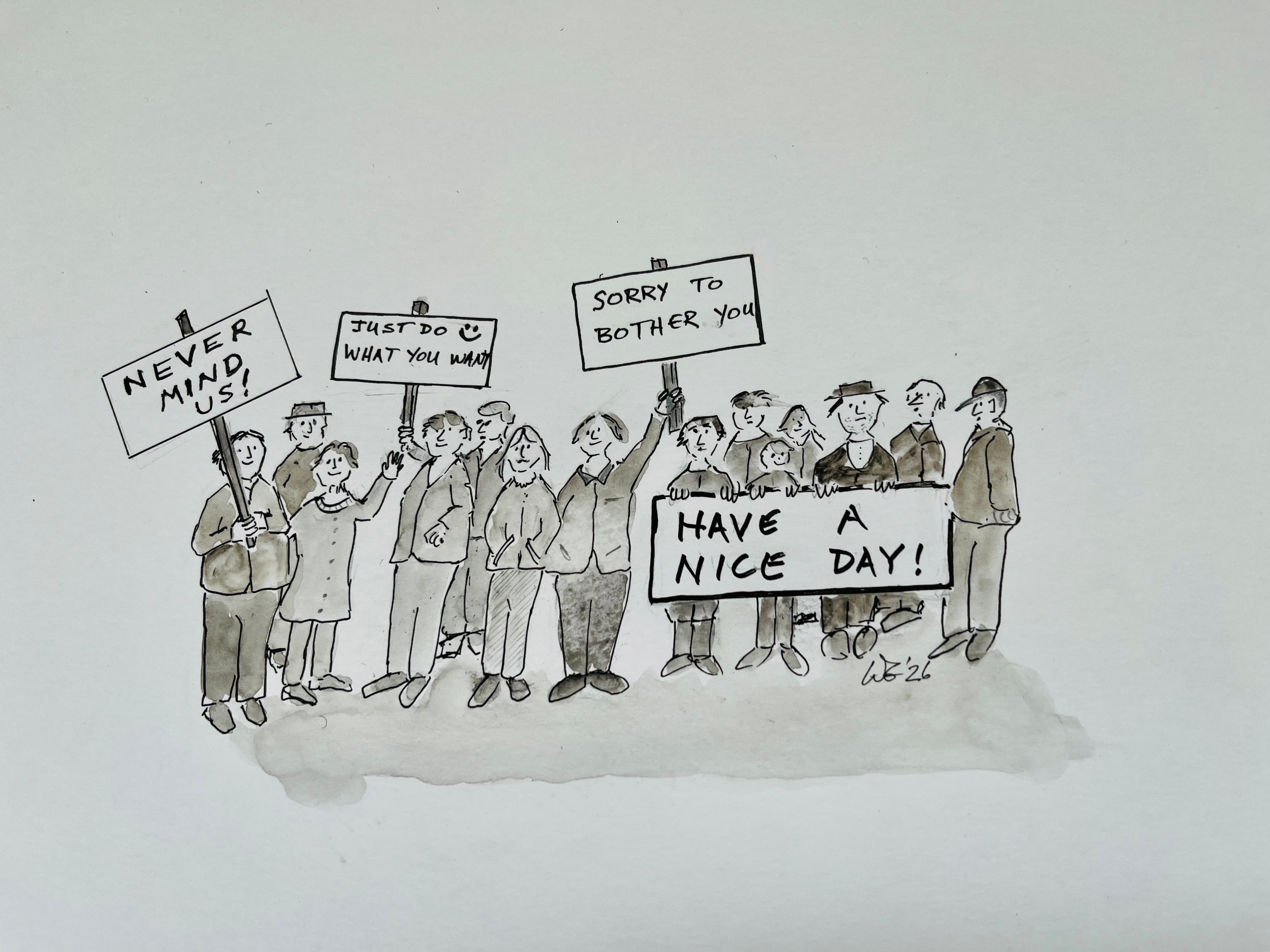
There have been several examples of this top-down ethos in the news lately, not all of them coming from the White House. In “The Data Centre Divide,” published in the June issue of Harper’s, Andrew Cockburn asks why, despite massive opposition to the vast number of AI data centres being built in North America, so little being done officially to stop them. Protests from the people whose hydro bills are going to skyrocket and whose wells are going to be sucked dry are largely ignored as lawmakers almost invariably let the projects go ahead. Since the pro-data-centre faction is driven by billionaires who contribute heavily to the campaign coffers of both Republican and Democratic legislators, the environmental and social impacts of mega data centres are dismissed and the proposals rubber-stamped.
“Given that we live under a political system that runs on money,” writes Cockburn, “it may prove impossible to stop data centres’ onward march, even if the grassroots rebellion continues its spread.”
SpaceX, the launcher of Starship spacecraft, is another example. The company is going public at the end of this month. In its Initial Public Offering (IPO), Elon Musk, the autocrat at the company’s breakfast table, has valued SpaceX at $1.75 trillion – 100 times its annual sales. Companies on the S&P 500 are typically valued at about 3 times sales. Apple was valued at 11 times sales and is doing very well, with annual returns of around 18 percent. Perhaps Musk had that figure in mind: if SpaceX shares perform as well as Apple’s, Musk will become the world’s first trillionaire. But, as Rana Foroohar writes in the Financial Times, “Musk controls 85 percent of shareholder votes and has pushed for such a tight command-and-control governance structure at SpaceX that shareholders would have very little influence, making it impossible to question or change anything directionally at the company.”
Most of us remember Shakespeare’s famous line: “Some are born great, some achieve greatness, and some have greatness thrust upon them.” It sounds like a positive statement. Until I looked it up, I thought it came from Julius Caesar, perhaps from a comment by Brutus on Caesar’s career as a statesman. I was wrong: it comes from Twelfth Night, from a letter written by Maria intended to trick the distasteful steward Malvolio into believing that his employer, Countess Olivia, is in love with him. “In my stars I am above thee,” the letter reads, which Malvolio thinks was written by Olivia, “but be not afraid of greatness. Some are born great, some achieve greatness, and some have greatness thrust upon them.” The inference is that he, too, could rise to greatness.
But when Malvolio acts upon this prank letter, he is humiliated, disgraced and imprisoned. “Be not afraid of greatness” is intentionally bad advice; even more so today, when the definition of greatness is conflated with notions of wealth and power. We should be afraid of power. Not everyone invested with it is great in the sense that Shakespeare intended, which had more to do with nobility of mind than with an artificially inflated ego.
What Brutus actually says about Caesar is more apt: “Th’ abuse of greatness is when it disjoins remorse from power.”
I didn’t see much in the way of remorse at the arts-organization meeting I attended, but it wasn’t greatness we were dealing with. It was pettifoggery. Nonetheless, it was still what human rights lawyer Pearl Eliadis would call “a threat to constitutional democracy.” Eliadis is speaking this week at a conference at McGill University entitled “Not Politics as Usual: Challenges to Constitutional Governance in Canada and the United States.” Such provisions as the rule of law, access to justice, and our unwritten constitutional principles, she says, “structure lawful governance itself,” and undermining them puts us all at risk. Although such threats are “less dramatic [in Canada] than those unfolding elsewhere, particularly in the United States, the still merit serious scrutiny.”
As Canadian poet and essayist Mark Abley writes in his book, Numb: The Politics of Overwhelm, “no country can boast of immunity to the virus of fascism.” Abley urges us to resist succumbing to the daily scarification that reading the news has become, not by retreating into a state of numbness that allows the sea of atrocities to continue, but by opposing, end them. The old adage, “Think globally, act locally,” may no longer be up to our present predicament. “Perhaps we need not just to act locally but to think locally,” he says. “We can take positive actions in our own neighbourhood, our own community. We can close our eyes and ears to fake news, and we can stop doomscrolling.”
It may not be much, he says, but it’s something. And something is better than nothing. For starters, we can refuse to allow the elected leaders of our organizations to flaunt the rules set down in their own constitutions.
This is such an important column. Wayne, I wish you would write something like this for the opinion section of the Globe. It’s interesting that nonprofits now call their executive directors CEOs as if they have the power of the president of a company when in fact, they are serving the boards which are supposed to run a nonprofit.
(Asking out of curiosity) Did no one point out to the Chair that he should not be speaking against or for the proposed motion? Or perhaps we plebs are not aware enough of the procedural rules and/or feel we cannot challenge “power”.