

Ghosts in the Machine

The Invention of Morel is a science fiction novel written in 1964 by the Argentine writer Adolfo Bioy Casares. It takes the form of a journal kept by a man hiding from the law on a deserted island in the Ellice Islands, which at the time was a British colony in the Pacific Ocean. He’d been told that “around 1924 a group of white men built a museum, a chapel, and a swimming pool on the island. The work was completed, and then abandoned.” The man rows there from Papua New Guinea, and lives in seclusion in the museum until, one day, to his astonishment, “the grassy hillside has become crowed with people who dance, stroll up and down, and swim in the pool.” The fugitive hides from the newcomers at first, observing their strangely repetitive behaviour, although when he makes himself visible to them they ignore him. He wonders of they are “ghosts.”
Eventually, the fugitive discovers that the people he is seeing are in fact holograms of people who had come to the island in 1924. Although digital recreations, they were indistinguishable from real human beings, a sort of solid ghosts. Morel’s invention is a machine that records a person’s entirety, their corporeal being as well as their physical senses and even, Morel claims, their souls. Morel recorded the people he had brought to the island, in the museum and on the hillside, then projected their holograms in a continuous loop. Because of a glitch in the system, however, the subjects themselves died after their images were taken. In other words, the images the fugitive sees are replacements of the humans whom Morel copied. What he is seeing is a week in the lives of the people Morel recorded in 1924, endlessly repeated.
It’s tempting to see The Invention of Morel as a prescient metaphor for artificial intelligence. Morel’s machine is a product of runaway technology; so is artificial intelligence. The New York Times reports that “artificial intelligence has brought a whole new level of fear and loathing” into the world. “Hollywood screenwriters and actors went on strike because they thought AI might replace them.” Their suspicions are not ungrounded. In the January 15 issue of the New York Review of Books, novelist Marilynne Robinson writes that “AI will enhance the efficiency of all it touches, we are told. More precisely, it will replace workers.” Elon Musk has said repeatedly that AI will increase productivity by replacing “inefficient” human workers with robots, and indeed, the Washington Post noted recently that in 2025 “nearly 300,000 employees were forced out of the federal workforce” by Musk’s Department of Government Efficiency. Other sources say the actual number is 317,000. During a debate with actor Keanu Reeves, Musk bragged that AI can produce feature-length films without using human actors: he showed a clip from one featuring a deep-fake Keanu Reeves. The debate is controversial, since some claim that it was actually generated by AI, but whether or not the debate was real, Musk has predicted that AI and robotics will replace human workers by the end of the century. Which sounds a lot like Morel’s vision of the ideal future.
Morel considered that his enhanced holograms, endowed with the ability to feel, taste, smell, and hear, were indistinguishable from their original subjects. “If we grant consciousness to the persons who surround us,” Morel says, “we shall have no valid reason to deny it to the persons created by my machinery.” Proponents of an AI future say the same thing. At Meta Connect 2023, Meta’s annual showcase of new products and technologies, Mark Zuckerberg boasted that “pretty soon, we’re going to be at a point where you’re going to be there physically with some of your friends, and others will be there digitally as avatars or holograms, and they’ll feel just as present as everyone else.” Morel, if he hadn’t been replaced by his own hologram, would have cheered.
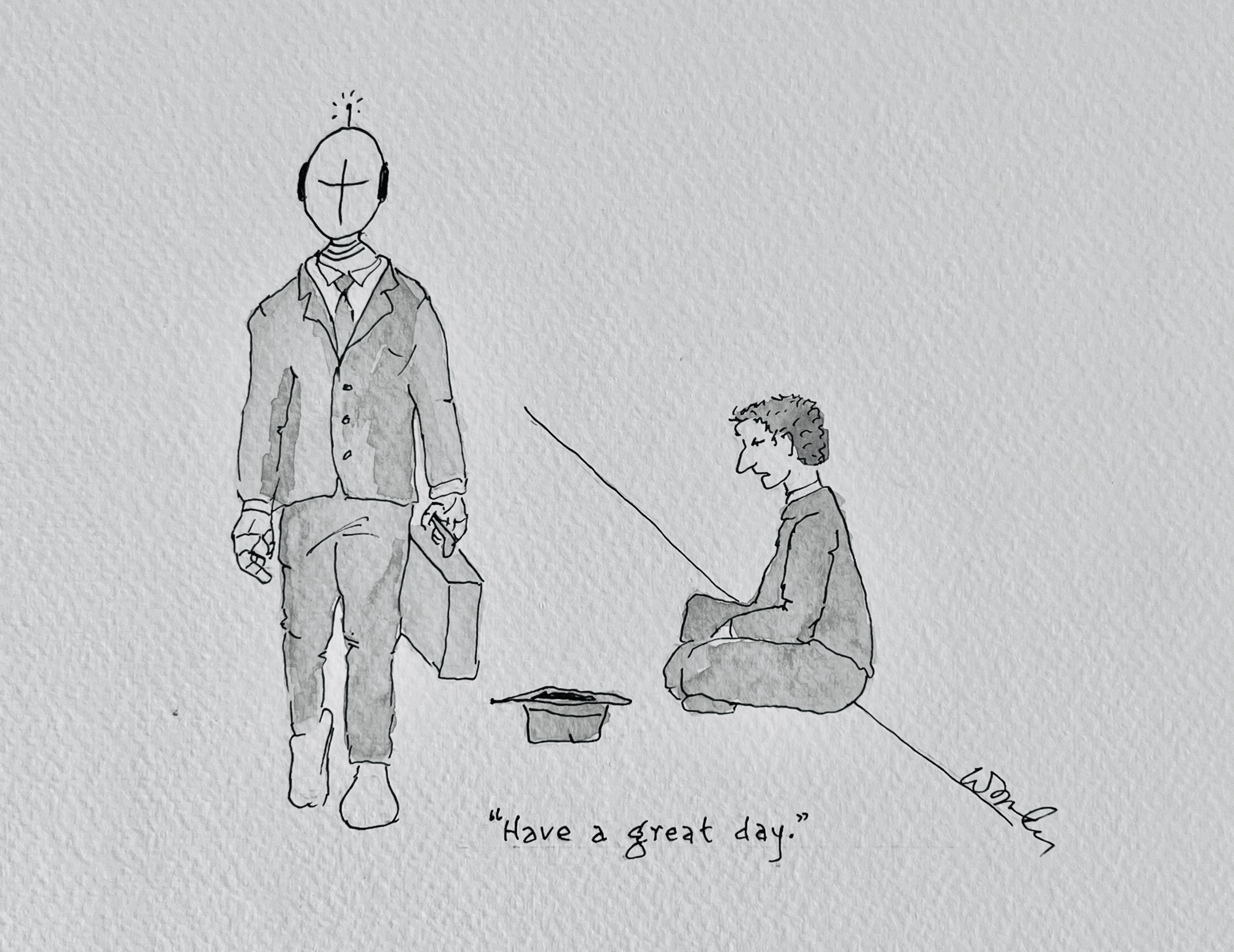
The fugitive on the island would not necessarily be repelled by the idea, either. “I have overcome the nervous repulsion I used to feel toward the images,” he says after a few weeks of walking among them. “They do not bother me now.” In fact, he falls in love with Faustine, one of the holographic women, and he determines to speak to her. When he does, however, she acts as though he doesn’t exist. Suspecting that Faustine can only recognize other holograms, the fugitive decides to make a hologram of himself, using Morel’s machine, even though he knows that he will die when the image is completed. However, his avatar, alongside Faustine’s, will live forever.
Despite initial opposition to new technologies, we have a history of accommodating ourselves to them. Even apparently beneficial inventions can have unforeseen consequences. When the iron plough was brought to Europe in the Middle Ages, the Church opposed it because it induced humans to improve on God’s creation, which the Church held was already perfect. But the plough was adopted because it was more efficient than the hoe, and therefore increased food production. On the other hand, it also put a lot of farmhands out of work, creating an unemployed working class that migrated into the towns (villes, in France), where they were called villains.
It’s possible that the future as envisioned by Zuckerberg, Musk, et.al. will produce a whole new class of villains. It has already ghosted 317,000 of them, workers who were deemed inefficient and so were slowing down the system. Some of them may even be accused of deliberately clogging up the works, like the Luddites in nineteenth-century England, or the saboteurs in France who threw their wooden shoes (sabots, or clogs) into mill machinery in an attempt to reduce the march of progress to a walking pace.
In The Invention of Morel, the mad scientist whose invention eliminates human beings by replacing them with “reconstructed persons” describes his achievement as creating “an album of very durable and clear images, which would be a legacy from the present to the future.”
Ah, yes, the legacy. Society’s one-percent, apparently, fantasize about leaving something behind that will live forever. Sometimes it’s a $400-million ballroom, sometimes it’s themselves. As Rebecca Solnit writes in No Straight Road Takes You There, “many tech billionaires do not believe they should be bound by the laws of nations or biology.” She cites Peter Thiel, the founder of PayPal, who has said, “I stand against confiscatory taxes, totalitarian collectives, and the ideology of the inevitability of the death of every individual.”
Not every individual, perhaps; just the villains.
The last century or so has been full of inventions and events predicted by sci-fi writers decades earlier. That seemed cool at first, but it's getting darker. In contrast to the (former) subscriber who accused you of advocating AI, I saw the opposite and agree with you.
Most biological humans do not want to be replaced by more efficient facsimiles, nor spend eternity dancing around a pool. Peter Thiel and his ilk are characters right out of a Bond novel, and my only hope at this point is that AI becomes smart enough to understand why he and his kind must be turned into holograms.
Feels like you’re on the AI train. Unsubscribed.